Skip to content
Phlogiston

$PHLO on Robinhood Chain

Every three minutes, the furnace eats its fees.

Every trade of $PHLO pays 1% into a pot. When the clock runs out, the whole pot becomes one buy of $PHLO, and every coin it buys is burned in the same transaction. No owner, no staking, no team wallet.

Live on Robinhood Chain mainnet, tested end to end on testnet

Reading the furnace…

3:00until the next firing
Last firing
None yet
Pot now
…
Volume, 24 h
…
Trades, 24 h
…
…
PHLO burned by the furnace
…
of the original billion, gone for good
…
turned into burns
…
firings so far

Price, and every firing under it

Reading the market…

Drag to pan, scroll to zoom, double-click to reset. Red marks are firings.

Loading the chart…

00.25000.50000.75001.0000

Latest firings

Whole ledger

No firings yet. The first one lands when the pot passes the minimum.

Trades feeding the pot

No trades yet. Every trade adds 1% to the pot.

On the record

The furnace runs on Robinhood Chain mainnet, and the same contract was tested end to end on testnet first. Every line below is a transaction you can open on the explorer.

Robinhood Chain testnet

Tested end to end

Chain 46630

Deployed
November 6, 2026 at 07:49 UTC, block 149,409,535
$PHLO launched
0xc2922c…6b3f9f
Gas for both
0.000054 ETH
Source code
Verified on Blockscout: Furnace, PhloToken

The test run, in order

  1. 1Buy 0.003 ETH of PHLO; 1% went into the pot. 0x6b6ff8…05d019
  2. 2Sell half of it back; 1% into the pot again. 0xc386f6…974aa5
  3. 3Launch a second coin, CALX, with a 0.001 ETH first buy. 0x301f57…7784e3
  4. 4Light the pot bought PHLO and burned all of it; the lighter got the 1% tip. 0xb094d2…1b9f2d

29,647.8 PHLO burned on the first firing; total supply fell to 999,970,352.2.

Contract tests: 19 unit and fuzz tests, plus a fork test that runs the whole flow against the real Uniswap v4 PoolManager on both networks. Both furnaces were deployed from 0x6C079ff20B77fBbc89Fb5C90c5f43Cf24166d7D4, the only address that could launch $PHLO, once. The source of all four contracts is verified as an exact match of the deployed bytecode.

How the furnace works

No staking, no claiming, no team wallet. Fees become firings, and firings become burns.

  1. I

    Fees go in the pot

    Every buy and every sell of $PHLO pays 1%, in ETH, into the furnace's pot. The contract holds it; no person can move it.

  2. II

    The clock runs out

    Every 180 seconds the furnace may be lit. Anyone can do it and earn the tip; the keeper does it when nobody else does, and nobody can do it early.

  3. III

    One buy

    The pot becomes a single buy of $PHLO in its own pool, less a 1% tip for whoever lights it. One buy may move the price at most 5%; anything left waits for the next firing.

  4. IV

    Burned in the same transaction

    Every coin that buy returns is burned with burn(). Total supply goes down on the explorer, and nothing sits in a wallet.

The rules, as the contract enforces them

The furnace is a Uniswap v4 hook. It takes its fee inside the pool itself, so it applies to every trade, whether it comes through this site, a wallet's swap screen or any other router.

All the coins were minted once, straight into the pool, as liquidity the contract holds forever. There is no function that removes it, no owner and no upgrade. The only address with a special power could launch the flagship once, and has done so.

A pot under the minimum waits for the next firing instead of wasting gas. Coins launched on the launchpad burn on the same clock, and a tenth of their fees buys and burns $PHLO.

The engine

A firing every
3 minutes
Fee on every trade
1%
Share of the pot burned
99%
Team cut
0%
Smallest pot that fires
0.0010 ETH
Largest price move per firing
5%
Launched coins feeding $PHLO
10% of their fees
Tip for whoever lights it
1% of the pot

Contract 0x2564357f5F49dc09Ff1250A4B79C81026beAE0cc. Read it, and check every burn, on the explorer.

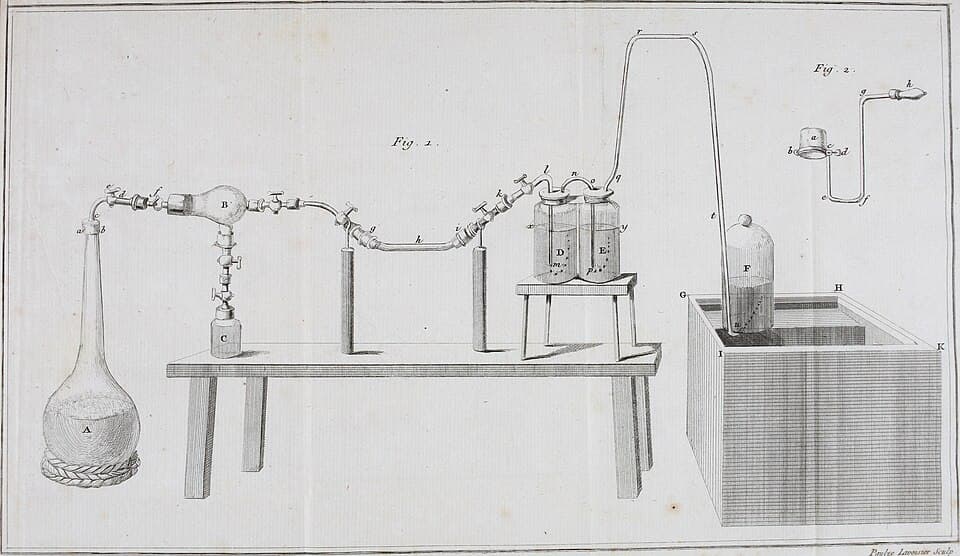
Engraving of an eighteenth-century chemistry apparatus: a large flask on a ring, tubes, two bottles on a stand and a water trough.
Apparatus from Lavoisier's Traité élémentaire de chimie (1789), engraved by Marie-Anne Paulze Lavoisier. Source. Internet Archive Book Images, via Wikimedia Commons. No known copyright restrictions.

Why phlogiston

In 1703 Georg Ernst Stahl taught that everything that burns gives off a substance he called phlogiston. Lavoisier's experiments in the 1770s and 1780s showed that burning is something taking oxygen in, not giving phlogiston off. The theory is gone. The name suits a coin whose supply is meant to leave a little at a time.

The engraving is from Lavoisier's own textbook, the book that retired phlogiston. Its plates were drawn and engraved by Marie-Anne Paulze Lavoisier.

Light your own furnace

Launch a coin on the same engine. It gets its own pool, its own pot and its own firing every three minutes, burning itself. A tenth of every one of its fees buys and burns $PHLO, so every coin on the pad feeds the original furnace.

of its fees burn your coin
90%of its fees burn your coin
of its fees burn $PHLO
10%of its fees burn $PHLO
kept by the team
0%kept by the team